On this Independence Day, not only do we celebrate the signing of the Declaration of Independence, but it also marks the anniversary of the passing of President John Adams and President Thomas Jefferson. They died within five hours of each other on this date in 1826, the 50thyear of the country they helped to found.
Adams and Jefferson were key patriots in the revolutionary effort and both contributed immensely to establish the democracy we have today. But after years of collaboration, the two differed significantly on how to run the country and they became bitter adversaries…
…until they chose to focus more on their commonalities than disagreements. Soon after Jefferson’s presidency, the two rekindled their friendship and became regular correspondents for the 14 years until their death.
I’m sure it was difficult for Adams to pen the initial letter to Jefferson offering an olive branch of reconciliation, but both men benefitted because he did. This Fourth of July, take a lesson from two of our country’s Founding Fathers and take the first step to find the higher ground in one of your relationships.

I am working on a major project with a colleague and we divided up the tasks equitably. Some tasks he is doing 100% and I am taking on other tasks, but we were both comfortable with the contribution of each other.
External events recently caused some circumstances to change, but we plodded on with the same workload distribution. Ironically, both of us recognized the need to realign some responsibilities but were hesitant to broach the subject: one for fear of being seen as doing too little and the other for fear of being seen as taking over or taking on too much. Once the topic was raised, we were able to quickly, amicably and appropriately shift who was doing what. It will make for a better project in the end and go a long way toward saving our sanity on the road to get there.
We often make asking for help harder than it should be. We internalize it as a sign of weakness when instead it is a sign of strength. It reminded me of the BRAVING acronym promoted by Brene Brown as a litmus test to define and develop trust-filled relationships. The “N” stands for NonJudgment: “I can ask for what I need, and you can ask for what you need. We can talk about how we feel without judgment.” I was grateful that I could have such a conversation focused on solutions instead of drama or guilt.
The next time your circumstances change and you need to adjust your responsibilities, I hope you find yourself in a partnership where a foundation of BRAVING has been established. Start today to cultivate it in all your relationships that matter.

People often wait until the last minute to complete a task, using the rationale that they were too busy to get the job done sooner. I think this is faulty logic.
Waiting until the last minute often requires more time – in part, because it makes it difficult for others to help you.
For example:
>If the content isn’t finalized, no one can help you develop the presentation or make copies.
>If the menu isn’t planned, someone else can’t get the groceries for you.
>If the vacation flight isn’t booked, others can’t reserve the car or line up the dog sitter.
>If your idea is still being changed up until the presentation, you are unable to brainstorm with others or get input.
>If you wait to write your grant right before it is due, you’re on your own to proof it, too.
>If you shop for a gift on the way to the party, you also need to buy a gift bag and tissue instead of having someone else wrap it at home.
And on it could go.
Investing in planning that allows you to delegate, share and receive feedback ultimately will pay you back with not only an improved outcome but one that requires less of you at the last minute. Time spent on the front end is exponentially more valuable than cramming on the back end.

This is the first Mother’s Day that I am without my mom and while I’m sure it’s not a new phenomenon for many, it is hard for me.
When I think about the mother/daughter relationship, not only do I think about my Mom, I think about the pseudo-mom role that I have played for the last decade. When I was working in St. Louis, I took a student from Georgia under my wing. Due to the distance, her parents were unable to regularly watch her play basketball in person, so I was that fan in the stands. If she needed someone as a guest for a banquet or awards ceremony, she called on me. For over a decade, to her, I am still “Momma T” even though this year she is a mom herself.
On Mother’s Day, think of mother as a verb and not a noun. How can you nurture someone who needs a little extra attention? Can you care for and protect someone who is vulnerable? In what ways can you build someone’s esteem and help them grow?
Whether you are male or female, use this holiday to mother someone in the best sense of the word. And if your Mom is still with you, be sure to give her a call and a big hug. Believe me, you’ll be thankful that you could.

I was one of the 121 crazies who waited in line for donuts yesterday, and I’ll bet that I was the only one who had an opportunity to purchase them but left empty handed.
I came to the truck so excited about the rare opportunity to enjoy these over-the-top delicious treats. I had fantasies as I anticipated what they would taste like and I had eagerly planned on indulging. But when I got to the front of the line, I learned that they were sold only as a “mixed dozen”. In other words, a grab bag.
I know that I could have spent my $16.50 and found someone to eat the donuts I did not want. Or, more likely, I know one friend and I could have eaten the whole dozen. But at the last second before purchase, I had a moment of clarity where I realized I was playing by the rules of their game and not making the purchase of the type or quantity that I wanted. I passed.
Grab bags were fun when you were a kid – when the element of surprise outweighed any sense of frugality or practicality – but as an adult, they have less appeal. Customers want what they want when they want it, and if they are going to take a risk on an unknown, there should be some compensation through a reduced price or increased quantity.
Think twice before you get carried away over a purchase. Just because there is a long line, it is a special sale, you have a coupon, or it is only available for a limited time doesn’t mean you need to grab it.
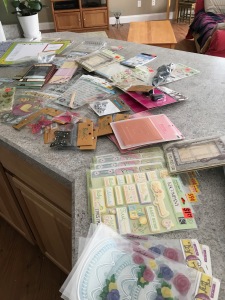 The $1 grab bag I did grab!
There was one beautiful day last week where we were able to enjoy spring, and then – boom -- winter returned. I think that warm weather flirting with us, even just for a brief moment, has made it harder to accept the subsequent drop in temperatures and resurfacing of snow.
There are many scenarios like this where a reprieve sounds like a good idea, but in the end, makes it worse when the new condition is only temporary. While we have no control over Mother Nature, I believe that it is harder to revert back to the original state after experiencing a better one. Examples include: having the puppy sleep in bed with you forever after an alleged one-night free pass from going in the crate; straying from your diet after having “just one” sweet that you have banished; or being even more upset about the required detour after a week of a re-opened path when work temporarily shifted. It would have been easier to have the puppy sleep in the crate, stay away from all sweets, or put up with the detour on an on-going basis.
If you have an unpleasant task or situation, don’t try to make it better for a bit. If you can’t sustain the change, you’re better off staying the course until the end. The discomfort quickly becomes the norm and there is no need to go through the initial pain more than once.

The irrational side of us wants to avoid learning information that we suspect will be negative. We don’t get our cholesterol checked because we fear that the numbers will be high. We pile up the bills instead of opening them if we worry that the checkbook doesn’t have enough funds to cover them. We stay off the scale rather than face the unwelcome number. We skip over that email on an unpleasant topic rather than reading it. We wait until April to look at our taxes because we dread learning how much we owe.
Ignoring unpleasant facts does not change them, rather it just depletes the time you have to remedy the situation. If you owe money, you owe it, regardless of whether you open the mail. And the sooner you know the details, the quicker you are able to make arrangements or develop options to deal with it.
Instead of speculating or avoiding negative news, embrace the knowingas a head start. You’ll have that much more time to reverse the situation if you spend your energy on the remedy instead of the avoidance.

A helpful strategy for achieving long-term goals can be “laddering” – a technique that encourages people to focus on the next rung (or next step) in the process rather than becoming overwhelmed by the long-term goal. For example, if you wish to earn an MBA, it helps to think of applying for admission or completing one course. If you aim to start a business, maybe you can begin a side hustle or work part-time in the field first. It’s not achieving your goal, but it helps move you toward it.
Yesterday I wrote about creating arbitrary milestones, a technique that can aid in short-term motivational power. These milestones can also be used as ladder rungs to propel you toward larger targets. No one says that the steps on your journey need to be even. You can invent your own incremental measurements and have the steps as close together – or as far apart – as inspiration and circumstances allow.
While having a long-term view is helpful to create the vision, keeping your focus on just the next rung may be just what you need to get you there.

As part of the research conducted by Brene Brown, she asked managers what behaviors helped to create trust in their direct reports. If like most people, you guess that the answer is dependability or accountability or something similar, you would be incorrect.
According to Brown, the number one trust-earning behavior is asking for help.
And yet, how many of us are reluctant to do so for fear that it makes us look weak or incompetent or unable to accomplish our goals. We carry additional stress and work ridiculous hours because we can’t muster the courage it takes to perform a behavior that actually enhances our standing with our manager (as well as relieves us of some of the task burden).
Asking for help isn’t something that is limited to your boss. It creates bonds with colleagues, in family relationships, among friends and in most settings where the vulnerability and intimacy required just to ask enhances the feeling of certitude about the person. After all, you don’t ask for help from someone that you don’t trust.
Don’t suffer in silence. The next time you could use a helping hand, wave yours at someone and ask for their assistance. It could be the lifeline you need in the short-term as well as create a bond with them to serve you in the future.

There will always be more to do. More that you could have done, and maybe even more that you should have done.
Those with the most balance in their lives are the ones who can take a moment to appreciate what they DID do.
We are all guilty of saying statements like: “I completed this task, and now I can do another.” Or “I did this, but it could have been better.” Yes, both may be true, but where is the recognition for what you did do?
I would encourage you personally, and certainly if you are the leader of a team, to be able to say “Yes!” – just “yes” and let that be enough for the moment. Celebrate yes, period, as a way of building up the energy to allow you to move forward and do that ‘more’.

Due to road construction by my house, I must endure a five-mile detour every time I go anywhere for the next three months. The alternate route takes me around to access the city from a different direction than I normally use so I have been relying more on GPS to navigate my trips.
For the past several destinations, I have pondered whether I should go via Route A or Route B and decided to check the Maps app to provide the answer. What I have learned is that there is no appreciable difference. On several occasions, both Route A and Route B have plotted out at the same amount of time, and even Route C may be just a minute or two longer.
I think we spend a lot of time and create undue stress for ourselves by debating over things that do not matter. Seth Godin recently wrote: “Choices don’t have to be decisions.”
Or, as my mom used to say: “Six of one, half a dozen of the other.”
If the difference in your choice is negligible, do not spend any of your energy making the decision. Save your brain power for where there is a perceptible difference to be made.

You may have heard the old saying: “Once in a blue moon”, but, if you’re like me, you did not really know what that meant. A blue moon occurs when there are two full moons in the same month, and tonight is that blue moon – something that usually only occurs every two-and-a-half years.
Many people painstakingly plan each week or calendar goals over months or quarters but think about the things that you should do once in a blue moon. Should you schedule a full-garage organization in that interval? Is it a good time to have all the office upholstery sent out for cleaning? Maybe a blue moon can be a good reminder to have a full read-and-review of the employee manual?
Or think about making the next blue moon your target for your next big goal: learn another language, save enough to travel on a safari, or enter that marathon.
Once in a blue moon will come whether you make it a milestone or not. Take advantage of nature’s reminder to do those occasional tasks or start that long-term project.
(Next blue moon = October 31, 2020)

A colleague was asked to join an external committee that did not particularly interest him but since it was good for the organization, he agreed to serve.
“I’m going in with an open mind and a servant’s attitude,” he said.
What a beautiful sentiment. More could not have been asked of him, and I suspect that he was more conscious about his commitment than many others on the board.
The next time you are asked to do something that is worthy, but not especially exciting for you, approach it with the same openness. The right mindset may make it a positive experience in the end.

Almost immediately after the tragic bridge collapse in Florida, the National Transportation Safety Board (NTSB) sent staff to the site to conduct an investigation. I admire these problem solvers whenever I hear about their work on the bridge, watch Sully or learn that they are en route to investigate a recent train or plane crash. They are wading into an area where emotions are high, the evidence is damaged or missing and the consequences of their work are great.
I often wonder what it takes to be an NTSB investigator, but I think there are parallels between the role and that of a coach. Both positions must have subject-matter expertise, along with the ability to assess a situation and draw conclusions based on observations of what is seen – or not seen. Both positions must be masterful at noting the details and minor variances from the norm. Both need to be able to make recommendations that improve future performance, even if it is unpopular to say them.
In the TED Talk by Atul Gawande (see dot #2013), he describes how he learned from the coach who observed his surgery – but the coach had to know the field intimately in order to give the recommendations for Gawande to hold his elbow differently or know how to reposition the light. Not just any outside observer can be helpful.
Coaches and the NTSB are knowledgeable eyes and ears with the sole purpose of seeing the situation for how it actually is – not how it was supposed to be, or how we think it was or even how we want it to be. They become highly focused on reality, providing a mirror back to the affected parties to describe the current situation with raw realism.
I hope you are never in a situation where the NTSB is actually needed rather I wish that you find yourself often with the gift of a coach who can bring an outside perspective to your work.

If I say: “coaching,” what is likely to come to mind is either an athletic coach or coaching for an executive leader. Many people have a narrow definition of what coaching is and the benefit that it offers.
I recently watched a TED Talk by Atul Gawande who advocated for a broader view of the practice. “Coaching is how people get better at what they do,” he said. “If professionals don’t realize there are problems, then they stop making improvements.”
Gawande, a surgeon and social entrepreneur, has used coaching to improve himself in the operating room and to decrease infant mortality in Indian hospitals. He was reluctant to allow an outside observer in his operating room but did so when evidence convinced him of the value of coaching. Gawande thought he conducted a flawless surgery, but the coach provided him with a page of observations that Gawande did not recognize were happening, and recommended changes that have made a marked difference in his practice.
The TED Talk provides examples of how Itzhak Perlman’s wife used to coach the great violinist from the audience and how most people could benefit from the perspective another person provides. I know from firsthand experience that a coach can see things that elude you or become so much a part of your routine that you no longer question them (even though you should!).
“Coaches are external eyes and ears, providing a more accurate picture of your reality,” Gawande says. “They recognize the fundamentals, break your actions down and help you build them back up again.”
No matter what your line of work, if you are serious about improvement, don't rely on just yourself to get you there.
Watch Gawande’s TED Talk: Want to get great at something? Get a coach.

There is a woman who I would guess to be in her 80s that walks by my house every day. Every. Day. She is more durable than the Post Office who delivers in snow, rain and heat because she walks on Sundays, too. No matter the weather or conditions, this woman trudges up the hill and makes her trek.
I think about her persistence – as I watch from my heated or air-conditioned office – and doubt that she questions her activity. I would guess that her walking is a habit – just as much a part of the day as eating meals or brushing teeth.
Gretchen Rubin advocates the cultivation of habits because they reduce (remove) the mental capacity necessary to make a decision. You don’t have to think about it -- and thus lose emotional energy in the process – you just do.
I admire those who engrain habits into their lives for the tough stuff. I have written 2090 dots and the process of sitting down to do them still doesn’t come easily. Often I spend as much time thinking about what to write as I do on the actual writing. I also think about whether I should take the dogs for a walk – is the weather ok, are the sidewalks free of salt or puddles, etc. I wish it would come naturally to just do it every day like this woman and not think about it.
I have quoted Susan Power before who writes that “motivation is in the doing.” Energy is generated in the doing too and depleted in the thinking-about-doing. Strive to minimize your energy loss by creating habits instead of daily decision points.

“How many books have you read?” That was the question one of my students asked me as I quoted a theory by memory in class last week.
The answer is “a lot – a very lot,” but what could make it seem like even more is that I read with the aim of applying the information that I read. My goal when I read a book (or article) is to distill one key nugget from it that I can remember and use. The information may be applicable for a blog, a class lesson, a workshop, a conversation starter or a tidbit to share with my sister in a letter, but my aim is to take away one tiny piece that I can add as a tool in my repertoire.
I think we often are exposed to so much information that we fail to absorb it in meaningful ways. By training myself to take a moment to capture one piece, I think it helps me to remember even more of the material.
I have used this technique with my students – I require them to read a book for class and then do a final presentation that teaches their classmates one point from the book. It’s far more engaging and beneficial than having them attempt to cram 200 pages of content into a ten-minute monologue where no one remembers anything that was said.
Think about using the “one point” method when you are processing input. Whether you attend a class/workshop/lecture, read a book/an article/a blog, or partake in any learning opportunity, I believe you’ll get more out of it in the short term if you position yourself to use one piece of information in the long term.
[See dot #108 on how to apply your learning nuggets to meetings.]

There was a meme on social media suggesting that the NRA becomes the National Reading Association and all the money currently spent on lobbying be redirected to libraries. Whether you agree with that idea or not, I think everyone can agree that fostering a love of reading among children is a good thing.
Today would be Dr. Seuss’s (Theodor Geisel) 114th birthday. It has become a day to celebrate reading – a present he would have been sure to enjoy. In our town, dozens of local leaders are participating in Read Across America Day by reading a Dr. Seuss book to elementary students across the tri-states. I will spend the afternoon making silly noises with kindergartners as I read Mr. Brown Can Moo – Can You? to them. I can hear the giggles now!
In addition to their on-going reading efforts, the school districts have highlighted reading by allowing the guest readers to come into the classrooms today. But it’s not only young people who need to read. Adults can benefit from the input non-fiction works provide them and they can be transported to another place and reduce their stress through the literary world of fiction.
Think of how your organization can incentivize reading by your staff. Maybe you can make it a norm to put a “reading hour” on the calendar – starting with the boss modeling this behavior. You can provide milk and cookies one morning a month and encourage staff to clear their calendar to delve into a new book in their field. You can ask for reading reports or recommendations at meetings. Start a voluntary book club with your staff. Put in a lending library. Offer each staff member one book a quarter on Amazon.
Whether through guest readers or organizational incentives, cultivating reading habits is a benefit to all. Break your routine of flipping on the television or grabbing an electronic device, and discover the magic that lurks in between the paper pages.

Organizations and companies invest significant resources in trying to recruit their customers and new employees. Some even invest time in trying to retain them, but those who do often dedicate minimal effort, certainly nothing to what they expend on the front end of the process.
But what if we looked at retention as re-recruiting.
My real estate broker from St. Louis continues to send me postcards quarterly, even though I have not lived there for ten years. He doesn’t rely on just retaining my relationship; he actively tries to re-recruit me several times a year.
How would you treat your employees if you sought to re-recruit them? Maybe you would do more paying attention to fit, aligning their skills, offering perks and benefits, talking about opportunities for advancement. Colleges who try to re-recruit their students continue to provide academic and co-curricular experiences that engage the students and prepare them for their future. Companies that wish to re-recruit customers continue to listen, provide new products in response to that feedback and offer samples or deals to entice people to say with them.
Retention can be passive whereas re-recruiting implies action and effort.
How will you approach the relationships you are in?

A colleague commented on yesterday’s post where I shared the list from the Minnesota Women’s March of ways to be engaged in activism. What he appreciated was the fact that there were many options and that it acknowledged not everyone would believe in everything or want to be actively engaged in a full-out common effort.
Many people have become so passionate about issues that there has developed an “all or none” mentality. You are for the Affordable Care Act or against it – precluding the possibility that you may like parts of it and want other components changed. You are for abortion or not, again, not allowing for nuances or exceptions that may shift your view. You are pro-Mac or pro-PC; a fan of charter schools and anti-everything-else, a believer in climate change or not.
More often than not these days, you choose a side.
How much more refreshing if you choose to listen or to “study” as the MN March list suggests. Or to learn more about the issue rather than blindly staking a claim for one position or another without fully understanding it.
In this season of gray skies, embrace the ambiguity that gray brings. You don’t have to jump from one side to the other, merely acknowledge that there is a potential for overlap in the vast middle in between.
Thanks, Brian!