Tuesday, February 7, 2017

leadership dot #1712: blow us all away

Eight months after we spent four hours on the phone procuring tickets, I finally was able to see the musical Hamilton. The energy around the whole neighborhood in Chicago was electric, with people in both blue jeans and fur coats posing for selfies outside the theatre marquee. And yes, all the hype is warranted.
I was surprised that at a Saturday evening production, we had the understudies for two of the main roles: Eliza Hamilton and Aaron Burr. As it turned out, our favorite two actors and those we thought had the strongest voices were -- you guessed it -- the actors who were Eliza and Burr. And the weakest link in the whole show, in our opinion, was the regular lead of Alexander himself.
The theatre is one of the masters of succession planning. They have cross-trained and prepared standby performers for all of their positions, and not just in a token way. The so-called "second string" is first rate, and able to assume the responsibilities in look, sound and function.
There are lessons your organization can learn from the theatre. Having more than one person trained in a role is costly and time-consuming, but allows for "non-stop" functioning of the work, and also allows the cast to "take a break." I would guess that knowing someone else is in the wings keeps the leads on their toes, and provides an incentive for the understudies to do well when they are asked to appear. 
What can your organization do to increase its performance depth? Having understudies for your key positions is as smart as the banking system that Hamilton first created.

Monday, February 6, 2017

leadership dot #1711: not barking

Most people are familiar with the Sherlock Holmes story in which the key clue for the detective was the watchdog that did not bark. Holmes termed the lack of barking as a "curious incident" that led to his conclusion that the burglar was a familiar person.
In the book The Amazon Way, John Rossman tells the story of how Amazon's Jeff Bezos related this to his company. Amazon had always done competitor analyses, but Bezos challenged his staff to think about the competitor that wasn't barking and could be a sleeping threat to the company. His staff came to identify Google, and Amazon's dependence on its systems. As a result, Amazon moved forward in creating its web services division.
Amazon Drive, as it is know known, is a worldwide leader in cloud computing. In 2016 Q1, it had $2.57 billion in revenue, $604 million in net income, and for the first time became more profitable than Amazon's retail operations. All because of a connection Bezos made to a Sherlock Holmes story.
What dog isn't barking in your competitive landscape? There is so much noise out there that often it is hard to make time to sit in the quiet and think. As Bezos and Sherlock agree, the quiet may be the most helpful information of all.
Sherlock Holmes Silver Blaze story by Sir Arthur Conan Doyle
The Amazon Way by John Rossman
Amazon financials from Wikipedia

Sunday, February 5, 2017

leadership dot #1710: animal wish list

I have long been a believer in the superpower of specificity, and here is another example that shows it in action.
Rather than asking for generic donations to "help the animals", Zoo New England created an Amazon Wish List with specific requests to fulfill their needs. You can find out that gorillas enjoy tea, but need the caffeine-free option or that chinchillas need a treadmill, or that some animals are on so many pills, they need a pill organizer! You can select the price range, type of item or animal that you'd like to help.
Could you use the Amazon Wish List concept for your organization? Certainly there are needs you have, and if you can find a way to make them specific enough, perhaps it will align with this format. It may be a great way to have your wishes fulfilled.
Thanks Meg!

Saturday, February 4, 2017

leadership dot #1709: reality

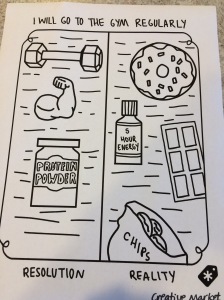
In the past year, there was a proliferation of coloring books for adults. Coloring seemed to be the latest new stress reduction technique, and books appeared everywhere. I, too, was caught up in the craze and acquired a book of mandalas and a spiffy set of colored pencils to color away my stress.
It quickly became evident that there were two problems with this: 1) I did not have much free time to wile away in coloring, and 2) when I did, it actually added to my frustration when trying to stay within the insanely small spaces that adult coloring book creators have concocted! 
Finally, a friend shared a coloring book that is stress-reducing and realistic. You can download your own copy here or view it here. This gem, from Creative Market, contrasts resolutions vs. reality and does so in a way that makes coloring entertaining. While targeted at graphic designers, I think we can all relate to the best of intentions becoming foiled when life intervenes.
What can you do in your world to align your resolutions with reality? It's great to have lofty goals, but sometimes achieving the less-lofty ones makes for a prettier picture all around.
Thanks, Tricia for sharing the Creative Market Blog
img_7129

Friday, February 3, 2017

leadership dot #1708: appetizer

When I eat out at a restaurant, I rarely order an appetizer even when it is offered. Instead, I begin with the entree. This may be a good strategy for dining, but in time management, sometimes it is best to begin the process with a nibble. 
If you start your major project with a "appetizer," it will seem less daunting than taking on the entree. An appetizer isn't a diversion separate from the meal, rather it is the first, smaller part of it. By adopting this philosophy to your project, you can start with an initial piece of what you need to do before diving in. Think of it as preparing an outline before you begin writing or assembling the tools before you begin a renovation project. It moves you forward without overwhelming you or filling you up.
Having an appetizer also motivates you to start, and as I have said many times, beginning is the hardest part of doing anything. So the next time your to-do list contains something that looks like a main dish or even multi-course meal, focus on the appetizer first and see if that strategy doesn't easily slide you right into the meat of the project.

Thursday, February 2, 2017

leadership dot #1707: play

On a recent drive, I listened to Brene Brown's Power of Vulnerability workshop which included her 10 Guideposts for Wholehearted Living. One of the guideposts that gave me pause was: Cultivate Play and Rest -- and Let Go of Exhaustion and Productivity as a Status Symbol. 
I have had several conversations about how people wear "too much to do" like a badge of honor, but I previously had not considered the role of true play toward our well being. It's not enough just to give up exhaustion and constant being-on-the-go, but Brene cites the work of Stuart Brown about the value of actual play. His definition: "play is time spent without purpose, time we don't want to end and where we lose the hyper-sense of self-consciousness." 
And when you really think about it, not much people do these days falls into that category. Kids are in organized activities. Families go on structured vacations. Even adults join clubs and organizations for social time, rather than engaging in silliness or putzing around at something just for the fun of it.
Brene notes a simple tactic that can help us shift the focus away from productivity to play. Instead of automatically asking people: "What do you do?" she advocates starting with "What do you love to do?" as a way to decouple self-worth and productivity. 
Think about what you love to do, and then make some time in your life to actually do it. The time you spend truly playing can be the most productive thing you can do for your well being in the long run.
The Power of Vulnerability: Teaching on Authenticity, Connection and Courage by Brene Brown, 2013

Wednesday, February 1, 2017

leadership dot #1706: volley

In volleyball, back and forth volleys make for an exciting match. It takes more power to get a kill or instantaneous point, but it is thrilling (for the audience at least) when the ball is hit back and forth over the net. 
Email is not like volleyball. If you find yourself in an email exchange that has volleyed back and forth more than a time or two, it's time to pick up the phone or have a face to face conversation with the parties involved. 
The volleyball player does not have a choice as to whether or not to keep returning the ball over the net. With email volleys, you do.