Showing posts with label culture. Show all posts

Monday, July 2, 2018

leadership dot #2208: lifestyle

I just returned from a fantastic trip to New York City, a place that could not be much more different from where I live. Everything about Manhattan screams energy and a frenetic pace – quite the contrast from life in small town Iowa.

When was in the Big Apple, I felt transported to another world not just a different city. “New York is a great place to visit but I wouldn’t want to live there,” I said to my sister. It reminded me of the corollary that is often said about our state: “Iowa is a great place to live but I wouldn’t want to visit.” There is truth to both statements.

It is difficult to describe the environment and sensory stimulation that occurs in much of central NYC just as it is challenging to articulate what makes life on the banks of the Mississippi so amenable to those who live there. Both are their own cultures and different people will be more comfortable in each of them.

Your job is to as accurately and thoroughly as possible describe your organization’s culture to anyone who may aspire to work with you. Are you a New York, an Iowa or someplace entirely different? If you’re asking people to make it their workplace home, it needs to be a long-term lifestyle fit not just a short-term vacation adventure.


Monday, June 25, 2018

leadership dot #2201: tracking

I recently learned about a new service called Bookshout, a company that provides audiobook codes to corporations so, in turn, they can distribute “books” to clients, prospective clients or employees. It creates a simple method of distribution, either allowing the recipient to choose which book they read or making it easy to get a required reading into the hands of everyone throughout the company. They claim that through Bookshout, people have read 8,400,820,497 words!

And they would know. Beyond promoting its distribution system, Bookshout also brags about its ability to track the use of the e-reader codes. For individuals, it allows people to set reading goals and track their progress against friends (or strangers) – in short, adding gamification to the leisure reading process. You can see how you rank in total words read vs. others in your social circle if you care to know that information.

For companies, Bookshout will “gather critical data to verify who is actually reading” – sharing with the company the code user’s reading habits and total words read. They promote it as "audio with accountability." So much for skimming the summary before your corporate retreat!

For some individuals, the tracking feature may be appealing, but in the company realm, it feels too intrusive for me. What kind of a culture does the corporation have if they have to monitor reading habits? And if you don’t trust your employees to read a book, how do you trust them with your product or service? Any goodwill that could be garnered by providing professional development or a common reading experience seems to be lost in the data collection.

Technology allows us to easily capture and report an increased level of detail and data. But just because you can doesn’t mean you should. In my mind, that goes for Bookshout, too.

Thursday, May 31, 2018

leadership dot #2176: prominent

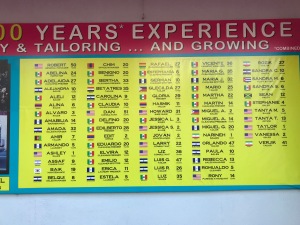
In my work with supervisors, I hear many laments about how hard it is to find people to fill jobs these days. They make it seem like it would be nearly impossible to find people to work the shifts at Milt and Edie’s drycleaners – a service business that is open 24/7/365. Not only do they need people to do the actual laundry, but they also offer alterations and tailoring during all those hours.

Yet Milt and Edie’s has found a way to keep people for extensive periods of time. They feature a large sign on their building that shares the name, the number of years worked and nationality of those who work there, and they tout the cumulative number of years’ experience they provide. Inside are flags of the countries of their employees. Next to the Alteration Center is a pegboard that features pictures of all the employees who are working that day.

Many organizations acknowledge longevity at a once-a-year ceremony or newsletter, but it was front and center at Milt and Edie’s. Think of how you can make your recognition efforts more personal and prominent. The future of your organization depends on your ability to have people operating it.

Friday, May 11, 2018

leadership dot #2156: bite

The arrival of the warmer weather is accompanied by the presence of ticks – those pinhead size insects that, when infected, can cause Lyme disease in humans. Lyme is serious stuff. Even with treatment it negatively impacts those who contract it for at least six months, causing fatigue, joint pain, headaches and even partial paralysis. Over 300,000 in the United States are diagnosed with Lyme each year.

Fleas are also out in full force, and those little bugs can transmit Bubonic plague to humans. The Plague sounds like an ancient disease – and, in fact, did kill over 50 million people in the 14thcentury – but it is still active today. Over 650 people year contract it and 100 of them die each year from the bacteria.

Even though they spread the diseases, the health of the ticks and fleas are not impacted. That which harms humans does not bother the bugs, thus, it allows for perpetuation without negative consequences to the host carrier.

I think about the parallels between fleas and ticks and the parasites who infect the culture of an organization. Often, they are tiny and inconspicuous – you may need to aggressively ferret them out to find them, but their small bites do tremendous harm to the organism. There is treatment, but no cure, and even with treatment the impact lasts for many months. Initially, you may think your actions have eradicated the problem, but it often lingers.

Just as you need to be diligent about watching for ticks and fleas and properly extracting them when found on your clothing, so it is true with the gossip-spreaders and negative-energy infectors in your organization. They may be small, but do not underestimate how debilitating their bite can be – even when you don’t notice it has happened.

Source:  Wikipedia

Monday, March 26, 2018

leadership dot #2110: sleep

Most organizations don’t go deep enough when articulating to their customers and employees what they truly offer, but one hotel succinctly and clearly articulated their core purpose. You may think that hotels offer beds or showers or shelter, but, as one Holiday Inn Express described it, what they really sell is sleep.

Being clear about this purpose allowed them to take steps to ensure that they could deliver it. Signs were posted in the lobby reminding others to keep the volume down. There were signs on each floor outside the elevator. Each guest had to sign an agreement acknowledging that they understood the “quiet hour” policy and would abide by it. The hotel staff reminded guests of the policies during check-in. They were serious about it, and you could tell.

Think about the core service that you deliver. For banks, it isn’t checking or savings, rather security. For colleges, it isn’t credits or degrees rather opportunity. For restaurants, it isn’t the food, rather the ambiance and dining experience that allows conversation and connection to occur.

The Holiday Inn Express staff were not the only ones delivering “sleep” to the guests. They created an environment and culture where everyone in the facility was working toward the same end. Isn’t that what we all dream of for our organizations?

Monday, February 26, 2018

leadership dot #2082: in conjunction

If you pay attention to the opening credits of movies, you will notice that they are longer than they used to be. Whereas one major studio used to bankroll an entire show, now you will see multiple production companies involved in presenting the film.

I first noticed this when I saw The Greatest Showman, brought to the theatre by three production companies. I thought this may be an anomaly given all the technical aspects of filming a musical, but it is not out of the norm. The Post, a basic drama, required six production companies. Shape of Water and Three Billboards each had three while Jumanji was produced by four different entities.

I think about the competitive nature of the movie industry, yet somehow it has become routine for multiple companies to collaborate instead of compete. They have pooled both fiscal resources and human talents to make something that would not be possible without a joint venture. And it’s not just a few companies; for the five films mentioned above 17 different production firms are involved.

How can you take a lesson from this and find ways to partner with those inside your industry? Your collaboration could become a showstopper for all of you.


The Post: Dreamworks Pictures, Twentieth Century Fox, Amblin Entertainment, Participant Media, Pascal Pictures, Star Thrower Entertainment
Shape of Water: Bull Productions, Double Dare You, Fox Searchlight Pictures
Three Billboards: Blueprint Pictures, Film 4, Fox Searchlight Pictures
Greatest Showman: Chernin Entertainment, TSG Entertainment, Twentieth Century Fox
Jumanji: Matt Tolmach Productions, Radar Pictures, Seven Bucks Productions, Sony Pictures Entertainment

Tuesday, January 30, 2018

leadership dot #2055: driver

What is an effective way to lessen anxiety in a stressful situation? Allow the person to have more control.

Rady Children’s Hospital in San Diego did just that by allowing children to drive themselves to the operating room using remote-controlled cars. Instead of being rolled into surgery on a gurney, children eagerly anticipate choosing a BMW, Cadillac, Mercedes or Lamborghini to transport them into the OR. It turns something that is dreaded into something that is a reward.

As the staff at Rady regrettably discovered, adults are too large to ride in the hospital’s special vehicles, so cars are probably not an option for your staff! But think of how you can devise a situation in which people have more control over something that normally would leave them feeling helpless. Can you allow them to have more autonomy in their work? Or to choose options instead of having them dictated from above? Or perhaps have the freedom to “opt out” of tasks or obligations on a limited basis?

Everyone likes to be in the driver’s seat. You can enhance your team morale by devising a way to hand your staff the keys.

Thanks, Amy!

Monday, January 29, 2018

leadership dot #2054: craft

Ten years ago this week, Starbucks closed all of its stores for three hours in order to conduct barista training. The signs on the doors read: “Taking time to perfect our espresso. Great espresso requires practice. That’s why we’re dedicating ourselves to honoring our craft.”*

The logistics involved in conducting the training were significant. Starbucks delivered DVDs and DVD players to each of its 7100 stores. It is estimated that they lost $6 million in revenue. But CEO Howard Schultz attributes the training to “saving the company.”

The logistics today could be much easier for companies who wish to conduct synchronous training: bring in a laptop and have everyone connect to the Internet and webinar software. Yet so few (any?) are willing to invest the time and forgo the revenue that such a commitment requires.

Leadership guru Simon Sinek says: “Leaders are not responsible for the results. Leaders are responsible for the people who are responsible for the results.” Howard Schultz understood that principle when he made the decision to close, and the company thrives today in part because of that choice.

What craft does your team need to practice – and how are you going to create the time for them to perfect that skill? Whether it is espresso or something more significant, your future depends upon making that commitment to your people.

*As quoted in an excerpt from Onward by Howard Schultz
Simon Sinek quote from Twitter 3/22/6 @SimonSinek

Monday, January 22, 2018

leadership dot #2047: kaleidoscope

Creating something impactful is like assembling a kaleidoscope.

A kaleidoscope is an assemblage of multiple small, colored pieces of glass. By themselves, they don’t seem like much, but when put together in the proper environment the pieces make beautiful patterns and create delight.

Oftentimes in organizations, I see evidence of many of the “pieces” but no one has intentionally unified them. Different departments or individuals often do things that help the same goal – creating pieces of colored glass – but no one evaluates them as a whole or packages the offerings as an intentional kaleidoscope.

Pieces of glass, no matter how colorful, have far less impact without the structure and cohesion that a kaleidoscope viewer provides.

When you think about your team or organization, assess what “pieces” you have in existence already and then consider how you can make them into something more. Can you build on impromptu recognition techniques to create a recognition program? Perhaps you can take your “pieces” of stress reduction and make them into a robust wellness initiative? Or maybe you can take your random volunteer work and make it into a full-fledged service program that reflects your values?

Part of the magic of a kaleidoscope is that not everyone sees all of the pieces in the same way. Focus on gathering the pieces and let individuals experience what you have created through their own perspective.

Sunday, January 14, 2018

leadership dot #2039: wires crossed

I recently donated blood and this was the office in which the staff took my vital signs and conducted my donation history:


Who thought that it was ok to leave the wiring like this? Did the installer prioritize speed over pride by leaving the job in this manner? Do the nurses even notice the entanglement when using this office to greet volunteer donors? Has the administration abdicated their responsibility for creating a professional atmosphere in which to conduct serious work?

I believe that the problem stems from the fact that it is a “general-use” office where multiple staff members meet with hosts of donors. No one has ownership of the space. It is used by everyone, so is cared for by no one.

Segments of highways receive more attention than this donor office.

Do you have common spaces in your organization that need to be “adopted” by someone to provide routine cleaning and inspection? Your space is part of your brand and reputation. Don’t let your wires get crossed as to who is responsible for maintaining it.

Tuesday, January 9, 2018

leadership dot #2034: listening

Former Commandant of the Marine Corps, Louis Wilson, Jr., remarked that by the time things got to his desk that everything was wonderful. He became tired of hearing sanitized versions of how things were going in the field and annoyed that people would tell him the positive side of the news to help situations look better.

To learn what was really going on, Wilson conducted a “listening tour” where he went into the field and to other facilities and asked people to tell him what the problems were. At first, he did not get much response, but eventually, people believed that he was serious and shared their impressions with the General.

As Commandant, Wilson was a full-time member of the Joint Chiefs of Staff and the highest-ranking Marine, yet he did not rest on those laurels or take the easy route to accept things at face value.

Maybe it is time for you to start the new year with a change of location. Get out there among your staff, peers and customers to learn what is really going on. You may need to spend some time convincing others of your sincerity and desire to hear the unvarnished truth, but it will be a wise investment of time. You can’t solve problems if you don’t know they exist.

Thanks, Curt!

Thursday, January 4, 2018

leadership dot #2029: escaping

Escape Rooms were the hot ticket over the holidays. Whether solving a bank heist, finding the pirate booty or helping the wizard reclaim his kingdom, the teens and tweens couldn’t get enough of them. My nieces and nephews drove an hour to participate in one at 9:40pm – the only time they could get a reservation.

For those unfamiliar with the premise, a small group enters a room and locates clues to solve a mystery. It is an exercise in problem-solving and logic intertwined with technology: put the wooden piece in the holder in a specific way so the invisible magnets touch and open another hatch or press the buttons in sequence to receive a new clue, etc.

Think about the Escape Room as a model for motivation. The rooms are all about the experience itself. There are no prizes or rewards (other than holding up a sign for the photo at the end). People take the task as seriously as if they were hired to do it, even though in reality they are the ones who paid for the privilege. There is a problem to be solved and groups work together to find the best solution.

How can you structure your work experience so people feel like they are in an Escape Room instead of wanting to escape your workplace? The intangible element of engagement is a far more powerful motivator than tangible rewards.


Thursday, December 14, 2017

leadership dot #2022: prepared

Before a snow flurry fell, I took dozens of actions to get prepared for the impending change of seasons:

Outdoors, I cleared the patio, put the hammock and grill away, moved plants indoors, cut back all the bushes, removed the hose, put my snow tires on and brought in the bird bath then the bird feeders. Inside I moved the sweaters to the prime drawer, put my sandals away, threw an extra cover on the bed, took the polish off my toes and ended pedicures. I stopped cutting the grass, bagged all the leaves and swapped the lawn mower for the snow blower in the garage.

Mother Nature sent all kinds of signals that winter was coming: the water in the dog’s dish freezes, the plants die, and gradually I go from wearing sweaters to coats to coats/mittens/scarf/hat. No one told me to stop wearing shorts or to turn off the air conditioner – it just made sense to do it.

Organizations should model their change efforts after the change in seasons. Help people understand what is coming and allow them to take steps along the way to prepare themselves physically and mentally for what is ahead. Point out the positives – like pomegranates, sweet potato fries, dogs on the bed at night and hot cocoa. Help them make minor adjustments to become ready for the new reality.

A night of steady 50mph winds brought us winter overnight and we went from 60 degrees to 30 degrees for highs. We may not like the change, but we were ready for it – which may be all you can ask for in your organization.


Monday, October 9, 2017

leadership dot #1956: team building

I continue to be astonished at how many organizations leave some of their most important people to fend for themselves and leave critical relationships to chance.

In organization after organization, I see people promoted to a supervisory role with little to no training on how to be effective in that drastically new position. Managers assume that if they had a star employee doing X that the person will remain a star when now supervising those who do X, even though the two skill sets are vastly different.

I also see too many organizations that believe because a group of people has a common function that they automatically become a team. Putting a group of people together under a heading on the organizational chart does nothing to take into account the dynamics of that relationship, the trust required to form a solid foundation or the challenges in communication that arise when multiple people are involved. Yet the organization offers little in terms of formal team building experiences or aid to the leader on how to create a cohesive unit.

This does not need to happen! There are many excellent resources and opportunities if only the organization wished to be intentional about building capacity in its key staff.

Don’t assume strong supervision or effective team development will happen on its own. Proactively investing in those who lead others permeates many levels and provides value throughout the whole organization.


Monday, September 25, 2017

leadership dot #1942: towards

I have a plant in my house that was growing like crazy – actually, too much to accommodate the pot it was in and the place where it was located – so I turned it away from the sun to slow the growth down.

And what happened?

The plant reoriented itself and sprouted a whole new batch of growth – reaching back across the plant in the direction of the sun. The light was so compelling that growing “towards” something overrode the obstacles designed to keep the plant at bay.


In your organization, work to be the light that provides a strong “why” or greater purpose that makes your employees determined to move in that direction even when there are barriers. What can you do today to be “the sun” and create a spot of inspiration that your people want to move towards, even when circumstances make it more difficult for them to do so?

Tuesday, September 12, 2017

leadership dot #1929: flooded

Even more impressive than the contributions of nearly a million pair of underwear in Houston is the story of the H-E-B grocery store chain and their efforts to continue supplying residents with essential needs post-hurricane.

The chain had over 80% of its stores operational despite the huge logistical challenges to do so. It was possible because of planning in advance, establishment of two command centers and a whatever-it-takes culture that empowered staff to operate outside the normal way of doing business. Volunteers came in from other H-E-B stores to help with stocking shelves. The manager talked directly with suppliers and even manufacturers to alter delivery schedules and instead take truckloads of the most needed products. The company took an intensely pragmatic approach: no frozen food, no floral, no variety – just the best sellers and as much bread, mops, bleach and water as was possible to receive. They used helicopters, contracted with the Army and would have used the corporate plane if Trump hadn’t closed the airspace.

I encourage you to read the fascinating full story for a back-of-the-house account of organizational mastery.

H-E-B brings disaster planning to a whole new level. While they could not plan for every situation, they knew what fundamentals to put in place in anticipation of pending crisis, and had the latitude to act once the disaster occurred. Would your organization be as simultaneously prepared and nimble?

Take a lesson from Houston H-E-B and division president Scott McClelland and take steps now to replicate parallel practices in your organization. You’ll be flooded with enough ambiguity if disaster occurs; better to prepare when you aren’t plugging the holes.

How does this dot connect with you? Leave a comment and share your observations with others.

Source: The inside story of what it took to keep a Texas grocery store chain running in the chaos of Hurricane Harvey by Chip Cutter on LinkedIn, September 2, 2017.

Sunday, September 3, 2017

leadership dot #1920: dress down

Last weekend, Major League Baseball celebrated Players Weekend and allowed the players to deviate from their standard uniforms and wear colorful attire on the field. Players were also allowed to use their nicknames on their jerseys instead of the traditional and standard last name.

Players took the field as “Cookie”, “El Mago”, “Mr. Smile” or “Toddfather”. Some used blue or purple bats or colorful cleats. It was the first time the Yankees were not in pinstripes.

All of the special jerseys were auctioned off for charity and the players probably had some fun with the variety. It was like “dress up day” at school where kids get a reprieve from wearing their uniform to come in pajamas or crazy combinations of clothes.

How can you take a page from the MLB playbook and mix up your dress code at work for a day? Maybe you allow staff to come in shorts and flip flops on a hot summer Friday. Or perhaps you go the other way and have a formal day when awards are given. Another option is to encourage spirit wear for local sporting events or to provide special t-shirts for a company occasion.

If a break with tradition can work for the Yankees, maybe your organization can hit a home run by allowing different attire for a day.

Source: Yankees break with legendary jersey tradition by Mike Fitzpatrick for the Associated Press in the Telegraph Herald, August 27, 2017, p. 4B.

How does this dot connect with you? Leave a comment and share your observations with others.

Thursday, August 31, 2017

leadership dot #1917: process

The final concept from Trevor Ragan’s Train Ugly presentation that I will share is the role of feedback in cultivating a learner focus (see dot #1916).

If people receive feedback on their performance, it reinforces the importance placed on outcomes and thus highlights the value in looking good. If you say to someone: “You are so great at X”, their mind has the propensity to translate that to “you get praise if you are good at X” so they take the easy road to remain good in this area, or negative feedback gets translated into “that is bad so I must be bad.” Bottom line: the focus stays on looking good vs. learning.

However, if you provide process focused feedback, you help them see the learning process and the focus remains on getting better. Saying: “You did a great job on X, how did you get so good at it?” helps acknowledge the process that can be repeated to do other great things. “You did a great job on X, you must have worked hard,” or “X didn’t go so well, what did you learn from it?” are all ways of helping the focus remain on the process.

I think about this as so many students are recently back to school. What will you say to your children when they bring home report cards or when your child texts you from college? How can you intentionally adjust your feedback to help them focus on “getting better” – even if they are great – vs. trying to look good in the future?

The same applies to organizations and supervisory feedback. Saying “that project went well” and leaving it at that fails to provide the process focus that will free your staff to experiment and take risks in the future.

The old adage is: “if you can’t say something nice, don’t say anything at all.” Change that mantra in your head to: “if you can’t say something about process (with both positive or negative feedback), don’t give feedback at all.”

To learn more, see http://www.trainugly.com

Wednesday, August 30, 2017

leadership dot #1916: getting better

Another concept from Trevor Ragan’s Train Ugly workshop centered around the learning opportunities that occur depending upon where we put our focus.

Choice one is to focus on outcomes – which results in an emphasis on looking good. People who choose this path often take the easy road because failure does not make them look good and that is the goal. Challenges are seen as threats and people with an outcomes focus go to great length to avoid them. If something has the potential to make you look bad, they avoid it, and thus miss out on great learning opportunities.

Choice two is to have a learner focus – which results in an emphasis on getting better. People who choose this path see challenges and failure as an opportunity to learn, so they seek more difficult experiences and learn more from them. Trevor called this “thinking like a scientist” – trying something and learning from the process more than the outcome. Failure is one more repetition in building your learner muscle.

Depending on which focus we choose, how we experience things and what we learn totally changes.

I thought about how this concept relates to the growth in STEM education. There has been a great push in STEM-related activities for children – everything from robotics teams to new Girl Scout badges – all in the quest to encourage more people to go into science or technology as careers. We certainly need that, but maybe a better outcome is that we are teaching more children how to think like a scientist. By pushing experimentation and a focus on process, we are helping people in all fields embrace learning and personal growth.

Maybe you work outside the STEM fields, but choose to think like a scientist. Work hard to create a culture in your organization that values getting better more than it does the initial outcome. By placing your focus on getting better, you inherently will get better, even if some of your attempts blow up along the way.

To learn more, see http://www.trainugly.com

Friday, August 25, 2017

leadership dot #1911: intention

At the event I wrote about yesterday, the balcony in the auditorium was roped off to compel participants to sit in the front section. By the time we arrived, the front appeared to be filling up rapidly, but the balcony remained closed. No one seemed to be taking any action to remedy this until someone finally stepped up and made the decision to open it. The person that opened the balcony wasn’t in charge of the program, but he saw a line full of people backed up into the lobby waiting to get in so he acted. It was a good thing that he did, as the balcony also became full before the program began.

I think about the many situations we have all been in where we could have done something, but instead waited for others to take the lead in doing so. We become too afraid of “getting in trouble” or doing the wrong thing, that instead, we do nothing.

We see a problem with a project or policy, but remain silent for fear of being reprimanded for speaking against authority. We observe a colleague struggling, but fail to offer help because we are not their boss. We know someone is not achieving the results they desire, but we don’t want to get involved to offer a suggestion to them.


Rear Admiral Grace Hopper said that it is easier to ask for forgiveness than it is to get permission. Cultivate that type of culture where intention outweighs hierarchy and let your people feel free to do what they think is best, whether they are in charge or not.