In my work with organizations, I often encounter people with lofty goals who want to develop the next big thing for their group. There is a focus on “add, add, add” and creating something new. I liken it to someone making a necklace by focusing on the baubles rather than the string.
I think a more pragmatic and productive approach is to begin by assessing the pearls that already exist in an organization. By pearls, I mean the strengths, existing programs, signature services, events or the brand assets that are in place and that connect to the goal. Next, consider how these can be assembled into a more powerful and cohesive whole to increase the impact without further taxing the resources to produce them. By identifying the “loose pearls” you already have that could be strung together into a “necklace”, it allows for more rapid evidence of progress and more clearly identifies the gaps that, if filled, could make the impact more robust.
The temptation is to “think big” so focusing on existing pearls often feels insignificant. However, tying a ribbon around current components or “stringing the pearls” doesn’t have to be the end point, just the starting one.
Remember that the classic pearl choker makes an impact without being flashy. No one ever said: “Oh, the pearls on that necklace are too small.”

I handled the logistics for a recent event, and at the end of the day, the organizer asked the participants if there was anything else they needed for the next day’s gathering. “I’d love some Mountain Dew!” one attendee said – a nod to the early hour at which her travel began.
So, of course, the next day there was Mountain Dew. No big deal.
Only it was. The presence of the beverage was reflected in the event evaluation – but not by the participant who requested it. Another attendee wrote: “I noticed the Mountain Dew,” read the evaluation. “You kept your promises.”
It reminded me of my time on campus when we conducted a student opinion survey. Among the multitude of suggestions, one was to put a pencil sharpener in the main classroom building. We did so almost immediately. The presence of that $10 item garnered us more goodwill than some of the more expensive solutions because it happened right away and showed that we really were listening.
Responsive actions may seem little to you, but they are anything but in the lives of others.

The arrival of the warmer weather is accompanied by the presence of ticks – those pinhead size insects that, when infected, can cause Lyme disease in humans. Lyme is serious stuff. Even with treatment it negatively impacts those who contract it for at least six months, causing fatigue, joint pain, headaches and even partial paralysis. Over 300,000 in the United States are diagnosed with Lyme each year.
Fleas are also out in full force, and those little bugs can transmit Bubonic plague to humans. The Plague sounds like an ancient disease – and, in fact, did kill over 50 million people in the 14thcentury – but it is still active today. Over 650 people year contract it and 100 of them die each year from the bacteria.
Even though they spread the diseases, the health of the ticks and fleas are not impacted. That which harms humans does not bother the bugs, thus, it allows for perpetuation without negative consequences to the host carrier.
I think about the parallels between fleas and ticks and the parasites who infect the culture of an organization. Often, they are tiny and inconspicuous – you may need to aggressively ferret them out to find them, but their small bites do tremendous harm to the organism. There is treatment, but no cure, and even with treatment the impact lasts for many months. Initially, you may think your actions have eradicated the problem, but it often lingers.
Just as you need to be diligent about watching for ticks and fleas and properly extracting them when found on your clothing, so it is true with the gossip-spreaders and negative-energy infectors in your organization. They may be small, but do not underestimate how debilitating their bite can be – even when you don’t notice it has happened.
Source: Wikipedia

Yesterday I wrote about the nightmare-waiting-to-happen parking situation on Main Street. I would bet that once the full impact of the scarcity is realized, there will be protestations by people who want something done about it.
Where were these people when the building permit was being reviewed? Most likely, they were oblivious to the fact it was even happening.
It is ironic that all of the money and attention is paid to the prominent elected positions when so much of what really impacts people happens at a much lower level. Committees and boards comprised of mostly volunteers often create the rulings that affect the average citizen. Zoning boards members are not elected but decide if multiple businesses can be on the same block with only 10 parking spaces. Even in higher offices, appointed staff members draft legislation for elected officials to vote on, but it is the behind-the-scenes author that shapes the details and truly determine the real impact.
And yet at the working meetings, it is rare if anyone shows up to voice an opinion. People don’t pay attention until something is passed that they don’t like and then they come to complain. How much more effective it would be if different voices were heard in the beginning. If there was an efficient system to let people know what was on the docket, not just what is a foregone conclusion via the minutes.
Government goes to those who show up. Yes, it takes an effort to know what is coming but making changes is much easier on the front end. Do your work to be informed or do your work to protest. You pick when you want to use your voice.

Many people pay attention to gas prices that are posted on the giant signs at the station, but how many people pay attention to what they are really being charged at the pump? Our local Sam’s Club is notorious for posting a lower price on the sign, but actually charging a higher price. The difference is usually only a few cents per gallon, but when you multiply that by the number of gallons and the number of people who are affected, it adds up. And it happens more times than not, so it is a system error, not a one-time mistake.
I have received my refund for the difference, but never a sincere apology. I have complained to three different managers (“Oh, I did not know; we’ll fix the sign”), but it continues to happen. I have even written the state Secretary of Agriculture, which resulted in the outside sign being removed but discrepancies continue inside.
We’re talking about a half dollar per fill-up, so maybe I should not care. My time to retrieve the refund and aggravation are worth far more than that. But where do you draw the line on transgressions that you let slide and those you try to fight?
I have always said that little=big: small things add up to affect culture, the environment, energy and change. You can’t make an issue out of everything, but if no one speaks up there is no incentive for violators to make things better.
In the words of the Civil Rights movement: “If not now, when?” “If not me, who?” Gas price deception is my issue de jour. What little improvement can be yours?


A helpful strategy for achieving long-term goals can be “laddering” – a technique that encourages people to focus on the next rung (or next step) in the process rather than becoming overwhelmed by the long-term goal. For example, if you wish to earn an MBA, it helps to think of applying for admission or completing one course. If you aim to start a business, maybe you can begin a side hustle or work part-time in the field first. It’s not achieving your goal, but it helps move you toward it.
Yesterday I wrote about creating arbitrary milestones, a technique that can aid in short-term motivational power. These milestones can also be used as ladder rungs to propel you toward larger targets. No one says that the steps on your journey need to be even. You can invent your own incremental measurements and have the steps as close together – or as far apart – as inspiration and circumstances allow.
While having a long-term view is helpful to create the vision, keeping your focus on just the next rung may be just what you need to get you there.

It has always been common practice to take a big goal and break it down into smaller steps and technology has made it so easy to do. We measure everything these days -- the number of steps you take in a day, the number of times you shop at a particular store, the number of reps during your workout – and more tracking provides greater opportunity for creating arbitrary milestones to celebrate.
In the era of computer gaming, recognition becomes even more important to do as gamers are used to achieving acknowledgment upon reaching intermediate “levels” – and soon the expectation will carry over into the workplace. As a supervisor, you can increase motivation by creating – then celebrating – interim steps on a long journey.
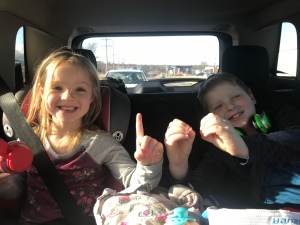
An example of this occurs in the St. Louis schools where the “100thDay of School” has become a big deal. There are special projects (eg: bringing in 100 items of something, writing 100 words, 100 Days t-shirts, 100 prizes, etc.). It has become so special that when two kids had to miss school that day for an out-of-town engagement, they shared their own 100 Days photo (below) on social media.
I have written before about the President’s 100 Daysand the arbitrary badges provided by Fitbit, but you can make anything seem special by so declaring it, even if it has no legitimate significance. Think about the big tasks you are facing: a tax season, a new equipment installation or a road trip with the family. How can you provide demarcation for moments along the way: free lunch when the 124threturn is filed, everyone does jumping jacks when the equipment is out of the box or you pull over for ice cream at the first exit after the 87thmile.
You possess the power to create something out of the ordinary at any point in a journey. Use that ability to motivate yourself and others to keep going.
Thanks, Brian!
How can you be part of a global environmental movement tonight between 8:30-9:30pm? By participating in Earth Hour, a grassroots movement of the World Wildlife Foundation. Each year, one hour is chosen where it is encouraged to “go dark” to stimulate conversations and actions about long-term environmental issues. Tonight’s the night!
People in over 180 countries will participate by switching off their lights for one hour (local time). The Eiffel Tower, Empire State Building and other landmarks will be dark. Earth Hour encourages you to turn off your lights as well: dine by candlelight, go stargazing, head to bed early, or sit around the fireplace.
There is always a tension between thinking BIG about long-term goals and thinking small in order to achieve those goals. Earth Hour is an attempt to straddle that line as it encourages small grassroots steps for a short period in an effort to create short-term awareness that leads to actions far beyond the Earth Hour.
You can participate directly in this environmental movement, and you can replicate the idea for other purposes. A specific action outside the norm can go a long way toward creating awareness. Being in the dark may shed the light that is necessary for change to occur.

“How many books have you read?” That was the question one of my students asked me as I quoted a theory by memory in class last week.
The answer is “a lot – a very lot,” but what could make it seem like even more is that I read with the aim of applying the information that I read. My goal when I read a book (or article) is to distill one key nugget from it that I can remember and use. The information may be applicable for a blog, a class lesson, a workshop, a conversation starter or a tidbit to share with my sister in a letter, but my aim is to take away one tiny piece that I can add as a tool in my repertoire.
I think we often are exposed to so much information that we fail to absorb it in meaningful ways. By training myself to take a moment to capture one piece, I think it helps me to remember even more of the material.
I have used this technique with my students – I require them to read a book for class and then do a final presentation that teaches their classmates one point from the book. It’s far more engaging and beneficial than having them attempt to cram 200 pages of content into a ten-minute monologue where no one remembers anything that was said.
Think about using the “one point” method when you are processing input. Whether you attend a class/workshop/lecture, read a book/an article/a blog, or partake in any learning opportunity, I believe you’ll get more out of it in the short term if you position yourself to use one piece of information in the long term.
[See dot #108 on how to apply your learning nuggets to meetings.]

I had a client who was lamenting the fact that she never seemed to have time to work on strategy development or the big issues that her department faced. Where could she find the time to do so?
The notion of “found” time is a misnomer; there are only so many hours in a day. instead of finding ways to add strategic time to her schedule, I suggested that she focus instead on cutting out a few of the little things that were consuming her minutes. It is less overwhelming to stop doing a few things – through elimination, delegation, or efficiency – than it is to feel daunted by the task of finding a few solid blocks of time.
And basic math would tell you that if you stop doing little things there will, in fact, be more disposable time. The trick is to bundle those minutes into something meaningful instead of letting them be frittered away by other little tasks in their stead.
It may seem like a mind game, but managing some small things is always a good start to getting control of the bigger things – with time, weight, emails and just about any cumulative task.
A bunch of little things equals a big thing – but the little side of the equation is easier to impact.

I have written before about how socks are the most requested items in homeless shelters. Not only do they keep your feet warm but clean socks also have an amazing ability to make you feel refreshed. This is a bonus for those in shelters who may not have access to clean clothes or showers, but even if you have a drawer full of Bombas or the finest hosiery, keep this tip in mind.
Switching your socks is a training tip that I learned long ago while attending a full-day workshop. The presenter had on very colorful and distinctive socks so we noticed it when he returned from break sporting a new pair. He insisted that just donning a clean pair of socks – with no other interventions – provided a boost of energy to get him through the long hours.
Whether you are attending a convention, retreat, or a day at an adventure park, socks are an easy-to-transport way to provide a refresh during the mid-day lull. Think of socks as cotton caffeine and use them the next time you need an energy boost!

I recently helped my sister complete the home stretch of submitting her doctoral dissertation. My job was to proofread the paper, help with formatting and put the list of references in proper APA style. We spent 13 hours a day, for two days, engrossed at the kitchen table completing these tasks.
In addition to learning proper comma placement for a government document/no author citation, it brought to light how we often underestimate the time it takes to create and maintain a solid infrastructure. For this paper, it required an extended period of time just to print the 216 pages, let alone proof them. I made substantial progress on a reading book while sitting at the printer waiting for the job to complete.
Our two days together was also a reminder that people bring different strengths to the table. My sister is visionary and excels at the big picture, but would have gone nuts if she had to plod through APA to get her references in order. She could do it, but it would have been harrowing. I can’t say that the task was fun for me either, but it was far better suited to my temperament.
On the next big project that you encounter, think about my sister’s dissertation. Remember that the message will be weakened if the mechanics become a distraction, so allow much more time than you expect to attend to the details and finishing touches. Find a partner with a different skill set than you have to complement the assignment of tasks and make them more palatable for all. And, of course, have more paper and toner on hand than you anticipate!
The last two days turned a draft into a dissertation. The devil isn’t in the details; the magic is.
P.S. Today is her defense: congratulations to Dr. Amy!!

At a recent Diversity Summit, the speaker, Dr. Jermaine Davis, encouraged people to follow the “principle of the slight edge.” He reminded us that Olympic athletes often win a medal by nanoseconds, not leaps and bounds, and that this same idea of incremental improvement can be applied to learning about diversity and inclusion.
It reminded me of a talk by author James Clear who spoke of developing habits that allow for a 1% improvement every day. He recounts the story of Dave Brailsford, the coach of the Brittish cycling team, who believed in the “aggregation of marginal gains.” Brailsford tended to every detail, including bringing pillows on the road so riders slept better, teaching hand washing skills to prevent colds and evaluating the effectiveness of different massage techniques on muscle recovery. His pattern of 1% improvements led to numerous Tour de France titles and Olympic Gold.
Whether it is in weight loss or profit gain, we are too often tempted to look for the silver bullet that will result in a big win. What Davis, Clear and Brailsford show is that the small, repeated behaviors are really the key to long-term success.
Break down your big goal into tiny habits to achieve victory.

Tonight is the 300th episode of the television drama Grey’s Anatomy. If the average episode is 42 minutes, that means I have already spent almost 210 hours as a couch potato because of this show.
OMG.
I could have written a book in that amount of time.
While some have spread their 12,558 minutes over the course of 14 seasons, I came late to the Grey’s party, but thanks to the marvel of Netflix, I was able to catch up. In a few months. Watching far more than 42 minutes at a stretch.
Binge watching has changed the landscape of how television is consumed. It is becoming increasingly rare to watch just one show and to watch it as it originally airs. Even people who could do that often save up a few past episodes so that they can watch them as a set – somehow making it more of an experience than an individual event.
Binge watching has implications far beyond television though. People are getting accustomed to (or should we say “being trained”) to consume things on an on-demand basis and to receive an on-going feed of content they desire. Membership sites with monthly fees are available for delivery of almost every product imaginable. Sites like Netflix and Hulu have vast repositories of content that extend lives of television shows and movies. Now if a show gets a good buzz as the series builds, they can still capture an audience. People want to be able to go back and “catch up” rather than being told they missed their opportunity.
Has your website and content delivery been repackaged to allow for “binge-access” for your clients? It’s no longer enough to just have information about the event: now you need to record it, share it and archive it forever. Have you preserved your newsletters, magazines and other content for someone to retrieve at any point so they are able to meet their need at the moment? Do you provide an easy way for someone to dive deep into your organization and learn about your services, such as when preparing for a job interview or to hire you as a client? Do you have educational resources available for customers to learn all they can about a topic when a specific problem arises?
Binge watching is the new norm for entertainment, but I predict it is going to spread over to consumption of educational content as well. Think about how you package your content so you don’t need a crash cart to resuscitate your brand.

A local financial firm is promoting a new set of services called StackStone Wealth. I love their graphic and messaging concept:
“Stone stacking is the art of creating sculptures by balancing rocks of all shapes and sizes. The artist works with only naturally available rocks, balancing them without glue or wires into beautiful, unique shapes. At StackStone Wealth, we strongly believe financial freedom is about balance. We work with your “financial stones” – investments, risk management and tax strategies – to help you build a beautiful, unique financial life…”

I
think that most people and most organizations could benefit by taking a stone stacking approach to life. In my organizational behavior class, we talk about this concept in different terms, but it is the same way that organizations build a culture: by balancing different elements of operation and process to provide a way of operating that takes the long-term into account. Relationships are built by staking small gestures and care to balance out transgressions that could occur. New strategies are infused into groups by rebalancing the stones to adjust time and effort in hopes of greater gain.
There are no “silver bullets” or shortcuts to attain the really big goals in life. If you have something of consequence on one side, the best way to achieve it is through an accumulation of small stones on the other side – working daily to create a balance between what you want in the short term and what you seek to acquire/become in the long term.
Happy Stacking!
Source: StackStone Wealth: A private wealth advisory practice of Ameriprise Financial, Inc.
I am a typography nerd, so when I discovered the link to the New York City Transit Authority Graphics Standards Manual, I reveled in the opportunity to see some of the iconic pages online (it is also now a book). The signage standards were first designed in 1970, and the strict adherence to them has made them one of NYC’s most famous landmarks.
Determining a font style, kerning and color palette does not seem like sexy work, but it is through the consistency of application that the subway signs have become art. There is no variance is what is acceptable and this repetition makes them memorable.
Those who write standards manuals and enforce the application of them are often seen as nitpickers. I remember supporting the graphic designer who reprinted an entire order of notecards because the color was slightly off. Others wanted to keep them and “use them internally” but we recycled the whole lot. I am sure the NYC subway folks would have done the same.
There is a dual meaning to “standard” – and creating a standards manual that you strictly follow will make your work a gold standard for others to follow.
 |
| http:standardsmanual.com |
If you have ever seen a Dale Chihuly sculpture, you know that they are a montage of intertwined glass in vibrant colors, with different shapes and colors assembled in unique and visually captivating forms.
Chihuly's work reminds me of yesterday’s dot, about how the Smithsonian curated a collection of John F. Kennedy photographs purchased from eBay. The exhibit exclusively utilized ordinary artifacts and made them special by their compilation. In a similar way, Chihuly utilizes individual pieces of glass that are not spectacular by themselves, but create stunning works of arts through their arrangement.
I think that too often we believe that greatness or creativity must be ONE.BIG.THING. -- a monumental discovery, an epic piece of art or a product that is truly magnificent. What Chihuly and the Smithsonian demonstrate is that little things can add up to create something with synergy greater than the individual pieces. Dots that are connected can result in something amazing and new, even though the components are not so special if considered alone.
Don’t let your fear of the mountain prevent you from taking that first step. Start from where you are, with what you have, and see if you don’t end up with something noteworthy by putting together the ordinary in new ways.

 Chihuly Sanctuary at the Buffet Cancer Center, Omaha
There are many things that you take for granted: that the city will notify you when your taxes are due, that they have the correct address to do so and that your sidewalks and streets aren’t for sale. But for a San Francisco community, none of these things proved to be true.
In a fluke case, an unpaid tax bill on the common areas of an exclusive private street (including sidewalks, the street and parking) caused the city to put the property up for sale. The bill ($994) went unpaid because the accountant’s address hadn’t been updated since the 1980s. So when the land went on the auction block, a real estate developer bought it and wants to charge the homeowners to park in front of their homes. Now there will be far more than $994 in legal bills as the new landowners and the long-time residents duel over who has control.
You know the morals of the story: Don’t take things for granted. Details matter. Little things can turn into large problems if left unchecked. Today is just a reminder to heed the wisdom.
Thanks Meg!
"You are setting an example -- whether you want to or not" read the marquee outside a local church. The quote gave me pause for both is magnitude and simplicity, as well as for the accuracy of its message. People truly are watching.
Think about the example you are setting for others around you. Do your colleagues see you delivering the stellar service that you would hope to receive? Are your children observing you make sacrifices to support causes you admire? Have you committed the time to your friends that will sustain a relationship or does work always come first?
You may think that people aren't paying attention, but when you consider how much you observe about others you'll realize that someone is learning from you. It is through the small actions more than the big ones that our legacy is communicated. Live like someone is watching.
While outside reading, I was bitten by an insect. It was so small and fast that I did not even see it -- until a spot on my hand became red. When I woke up, the whole area was inflamed, and by mid-morning I was heading to the store for Benadryl. I could concentrate on nothing else -- all because of something I did not even notice initially.
Is one of your organization's employees like that insect -- stealthily spreading toxicity throughout your organization? Maybe they are not loudly protesting or causing a scene, but if they are buzzing from person to person leaving a negative reaction behind the effect is even more powerful. Others may not even realize what is causing their itch, but it is distracting them nonetheless.
As the leader, you are responsible for administering the equivalent of organizational Benadryl or deploying the swatter. Don't let size fool you. Something so small can have a disproportionately big impact if you don't stop it.