So many new products and services come about because of an additional feature or enhanced component but think about the success stories that are because of what they subtracted.
Acute care centers created a whole new level of medical treatment when they did without the extensive services that an emergency room can provide. Southwest captured the vacation traveler niche when it did without in-flight amenities and complex booking procedures. A whole category of budget hotels became popular by foregoing room service, restaurants and concierges. Planet Fitness focused on the average person who wanted to stay in shape and left the serious bodybuilders to go elsewhere.
Dry shampoo is a whole new market that left the water behind. Pepper focused on whole peppercorns and fresh grinders without worrying about the salt component to the spice set. Salt created its own niche with a push for sea salt as a premium product. Our local movie theatre made a name for itself for its popcorn as much as for its movies.
Opportunities abound when you decouple items that are traditionally paired and focus on creating a uniqueness with one component. The next time you’re looking to provide something new ask yourself what you should leave out to achieve it.

Treat bags are standard fare at birthday parties for young children, but what do you give as a favor when the party is for an octogenarian? And what do you give the birthday girl herself?
One family solved both problems by custom-designing a coloring book featuring friends, family and memories of the guest of honor. She loved it, of course, but it also made for a fun memento for those in attendance.
Sometimes, the perfect present or favor isn’t out there and you have to create your own. Whether it be for a special birthday, company anniversary, team milestone or any other date you wish to commemorate, consider coloring your way into a nontraditional gift solution.
Thanks, Lucy!


Dr. Temple Grandin is an internationally known expert in the field of autism. She has written a dozen books on the topic, speaks widely about the condition and has been featured in a film.
Just knowing those facts, guess what her “day job” is. Therapist? Psychologist? Doctor? Professor?
If you guessed professor, you would be right, but what I doubt you suspected is that she is a professor of animal science at Colorado State University. In addition to being an expert on autism, she is also well known for her work in cattle handling!
You may think the two are unrelated, but Dr. Grandin has used her own autism to have insights about the environment in which livestock live. She has created protocols for reducing visual distractions and adding enrichments in the animal environment and championed many improvements for more humane livestock handling. Her autistic sensitivity has translated to how to improve conditions and animal behavior. On second glance, autism and animal science seem like a natural connection.
How can you pair a diverse set of interests or insights to shape the world in ways that others cannot fathom? Your unique combination could be just what is needed to see the world more humanely.
 Source: Wikipedia Temple Grandin
Source: "Speaker: A little bit of autism gives you an advantage" by Bennet Goldstein, Telegraph Herald, April 27, 2018, p. 3A
I was one of the 121 crazies who waited in line for donuts yesterday, and I’ll bet that I was the only one who had an opportunity to purchase them but left empty handed.
I came to the truck so excited about the rare opportunity to enjoy these over-the-top delicious treats. I had fantasies as I anticipated what they would taste like and I had eagerly planned on indulging. But when I got to the front of the line, I learned that they were sold only as a “mixed dozen”. In other words, a grab bag.
I know that I could have spent my $16.50 and found someone to eat the donuts I did not want. Or, more likely, I know one friend and I could have eaten the whole dozen. But at the last second before purchase, I had a moment of clarity where I realized I was playing by the rules of their game and not making the purchase of the type or quantity that I wanted. I passed.
Grab bags were fun when you were a kid – when the element of surprise outweighed any sense of frugality or practicality – but as an adult, they have less appeal. Customers want what they want when they want it, and if they are going to take a risk on an unknown, there should be some compensation through a reduced price or increased quantity.
Think twice before you get carried away over a purchase. Just because there is a long line, it is a special sale, you have a coupon, or it is only available for a limited time doesn’t mean you need to grab it.
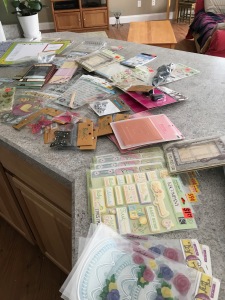 The $1 grab bag I did grab!
Talk about being able to create an experience: the out-of-town donut shop brought its “Emergency Donut Vehicle” to our city today. It’s a retrofitted ambulance, so we were greeted with sirens and lights when it turned into the parking lot – and they were greeted by 121 people in line before it opened.
The outside of the vehicle added to the festivity with their spaces for long john storage, emergency jelly pump, sprinkle storage bins and icing bandages. Overall it made for an out-of-the-ordinary noon hour for dozens of people in line as well as the dozens back at home or in the office who were able to partake in the dozens of donuts being distributed out of the “ambulance.”
I did not stay until the end, but the clerk said that last time they were in town, the packed-full vehicle was sold out in a half hour. What a way to generate business.
I doubt that if they had a bakery in town that it would have created this much buzz on this particular day. While they may have steady sales, people would not wait an hour in line and buy multiple dozen donuts at noon on a regular basis. Today’s levity succeeded because of the novelty and scarcity.
Think about how your organization can make something you provide less accessible. Is there a way for you to create demand because of the difficulty in obtaining a product or service? Should you shrink an element of your distribution in order to ultimately expand it? Would something be more popular if it was limited?
Maybe a manufactured emergency is just what the donut doctor ordered for you.

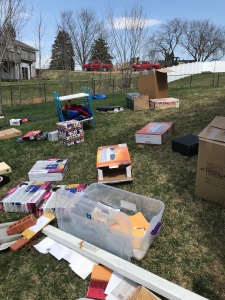
The aftermath of yesterday’s flood won’t just leave behind water-soaked boxes and soggy possessions; what will linger after everything has dried is doubt. I know already that there will come a day when I am looking for something and I will wonder: “Is it here somewhere or did it get thrown out in the flood?”
Experience has shown me that doubt is a great energy drain. I have some files upstairs in my office and some in the basement, and I find myself too easily giving up the hunt for something because I believe it is in the other location. This necessitates a search in the second place, only to have me return with more diligence to find the item where I thought it was initially. Had there not been doubt, I would have persisted and found it in far less time. Doubt also happens whenever I do a serious purging, when I travel or when I do anything to disrupt the natural order of my routines.
Whenever you have a plausible scapegoat – whether that be a person, a place or any multitude of options – our natural tendency is to jump on doubt as the default response. Strive to minimize the opportunities for doubt to creep into your organization. Doubt-busting examples could include: specify one person responsible for a project so there is no question who needs to do that task; have designated spots for key items so people can tell at a glance whether something is available or not, and keep records and documentation to add clarity to decisions.
Your time is better spent on something besides futile wondering.

It was a simple thing, really – my housemate had just hooked up the hose and was giving the new blossoms a drink of fresh water. Fortuitously, I was in the basement at the time – just the right place to hear the waterfall cascading down from my basement ceiling. It seems that the outer pipe froze during this bitterly cold winter, but, unlike the rest of us, did not live through it. Thus, when the hose was on, it was a rainfall inside the house.
We often have torrential rains and I have always worried about basement flooding, but never from above. The palettes I had as “protection” did little and the generator in case the sump pump goes out was irrelevant. It was actually the tarp to protect things from drywall dust that did the most good, and that was never part of my flood mitigation plan.
In our homes and in our organizations, we can practice precautions and take steps to minimize risk, but it isn’t always enough. Sometimes your damage control depends purely on luck – whether you define that as good or bad – and you just need to deal with what life pours on you, even when it comes from above.