Saturday, May 7, 2016

#1436 relief

When I think of customer service, I think of accommodating the needs of people, but lately airports are thinking more broadly than that. Now they are providing special rest areas for traveling pets.

It makes sense that the animals would have a need to "use the facilities" during layovers, and rather than make their owners go through security again, major hubs are installing special "Animal Relief Areas". 

Facilities come with artificial turf and hoses, and I'm sure a plethora of scents that will make the dogs feel right at home. The one in New York's Kennedy airport even has a fire hydrant to make dogs inclined to do their business.

Over 2 million animals are booked on commercial planes each year. At least now they'll have a place to relieve themselves from the stress of flying!

Think about who all your customers are, whether they have two legs or four, and try to provide the best service you can for all of them. 

--beth triplett
leadershipdots.blogspot.com
@leadershipdots
leadershipdots@gmail.com


Partial source: Wee-lief! Dogs get airport bathrooms of their own from the Associated Press in the Telegraph Herald, May 1, 2016

Animal Relief Area at O'Hare


Friday, May 6, 2016

#1435 utility

There is so much of our world that we don't really pay attention to. Power lines would be an example of that. 

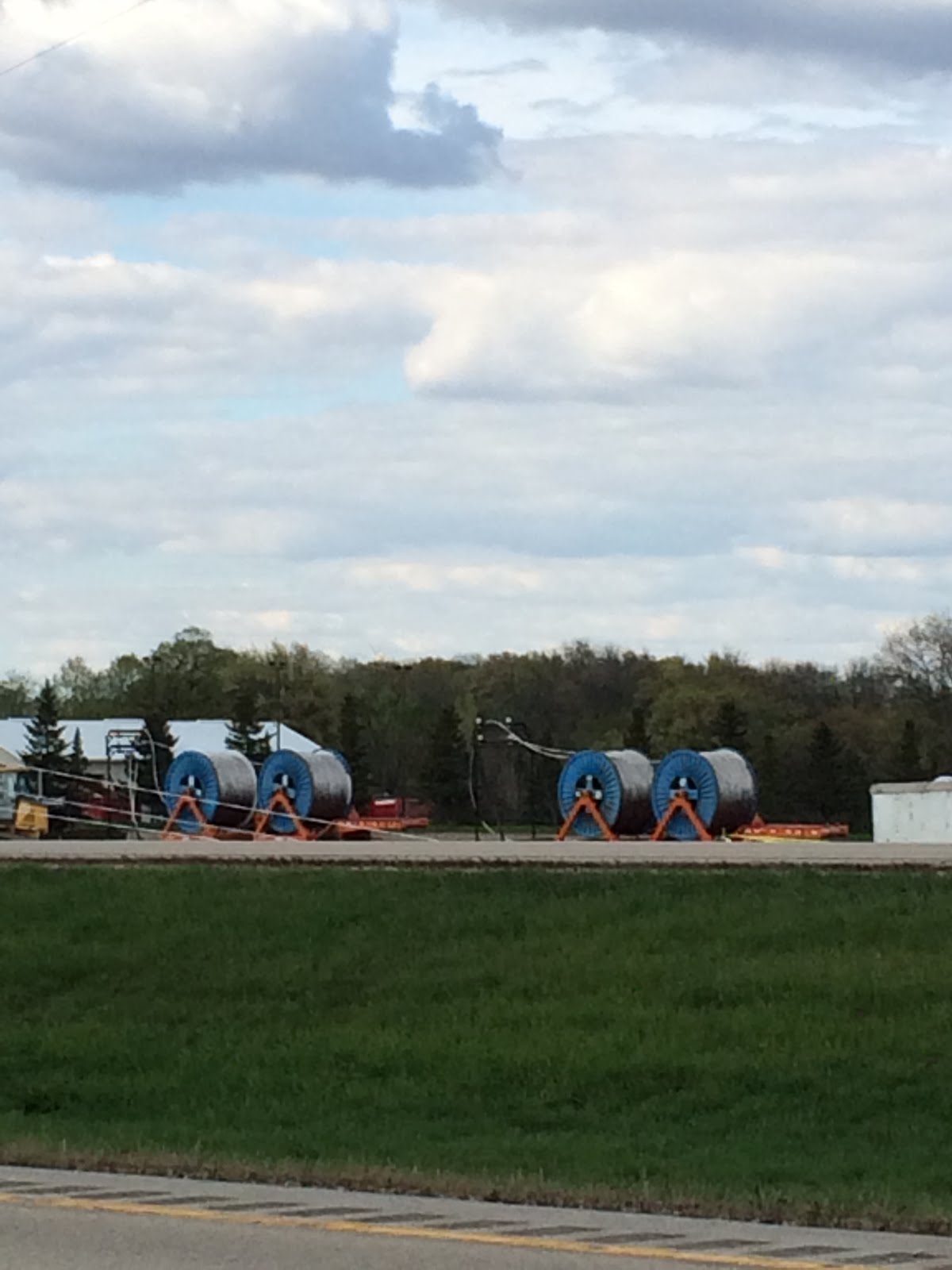
On a recent trip, I noticed that there were men working along the road, installing new power poles and lines. This was quite an ordeal, as they had to construct platforms with railroad ties for the large equipment to access the points, assemble the poles in multiple pieces because of their size, and then use helicopters to reach the highest points to string the lines. 

But until I saw the men and the signs warning me of utility work from December until May, I hadn't noticed the poles that were already installed. They just blended into the background, even though they are several stories tall.

On the way home, I paid attention, and realized that the poles went on for about 20 miles that I could see -- 184 poles every tenth of a mile!  (They were numbered; I wasn't that bored!) 

I can't imagine the cost for this installation project, but obviously the power company believes that it is a worthwhile investment in infrastructure. What non-glamorous but essential component of your organization should you pay more attention to? Is there a piece of equipment or process that warrants a new look? Is there something you don't see that you should?

I missed about 15 miles of power poles on my original trip. Don't let your infrastructure fade into the background and lose its power.

-- beth triplett
leadershipdots@blogspot.com
@leadershipdots
leadershipdots@gmail.com
Note the scale of the pole vs. large truck next to it


Thursday, May 5, 2016

#1434 inflated

In one of my latest garage sale adventures in Iowa, my friend Tracy from Connecticut was with me. At one house, she found a giant inflatable cactus. For fifty cents! Immediately she knew that it would have a place on her patio for a Cinco de Mayo celebration. So she deflated it and packed it in her suitcase.

Accompanying this treasure was an inflatable football helmet from the same sale (Super Bowl party anyone?) and other assorted garage sale purchases. For some reason, TSA decided to search her suitcase on the way home. Doesn't everyone in the traveling public have a few bigger-than-life inflatables in their bag?

It has often been said that "one man's trash is another man's treasure." And this blog has often said that you need to connect the dots from one experience to another. Tracy did not come to Iowa with the thought of purchasing a holiday decoration, but made the connection as soon as she saw it. And her party today will be more festive as a result.

How can you inflate your imagination to see the possibilities in unrelated events? It may garner you some prickly looks from TSA, but it will be worth it.

Happy Cinco de Mayo!

-- beth triplett
leadershipdots.blogspot.com
@leadershipdots
leadershipdots@gmail.com 


Wednesday, May 4, 2016

#1433 the world

In a sermon I recently heard, the priest* told a story about his childhood. When he was a young boy, his neighbor Myrtle was his babysitter. Every afternoon, Myrtle's friend, her dog and the boy would pile into Myrtle's Pontiac and visit "whatever country" he wanted to visit that day.

This was accomplished through the miracle of imagination -- and a View-Master with reels showing important places from various countries. He could look out the window through the View-Master and see the sights as if he were there in person. And much to his amazement, Myrtle and her friend spoke every language, so their car conversations changed according to which country they were visiting that afternoon. The View-Master trips served as entertainment, education and a delightful way to stimulate his interest in other countries. 

We all need someone like Myrtle in our life who shows us a world bigger than we can see on our own. Who can you inspire today by sharing your imagination and possibilities with them?

-- beth triplett
leadershipdots.blogspot.com
@leadershipdots
leadershipdots@gmail.com

*Fr. James Cassidy, St. Joan of Arc Parish, Minneapolis

Tuesday, May 3, 2016

#1432 route

There are two main routes between where I live and the Twin Cities:

Route A is 312 miles and is estimated to take 5 hours and 3 minutes.

Route B is 253 miles and should take you 4 hours and 37 minutes.

Just looking at those facts would cause most people to automatically pick Route B -- it's shorter and faster. But if you look closely, you'll see that going an additional 59 miles in Route A takes you just 26 minutes more. That's because Route B winds through many small towns, meaning the majority of the trip is on two-lane roads where there are stop signs and speed limits, some as low as 25 mph.

So, if it is a perfect day weather-wise and you are inclined to pay attention to varying speeds and many turns, Route B is the one for you. If you'd rather pop in an audio book, set the cruise to 70 and have four-lane roads the entire trip, then you should spend the extra half hour and take Route A.

Traveling to Minneapolis, as with most decisions you make in your organization, comes with a choice. Neither is automatically right or wrong, but which way you travel should be an intentional decision. Think about what you value most before you select your route.

-- beth triplett
leadershipdots.blogspot.com
@leadershipdots
leadershipdots@gmail.com


Monday, May 2, 2016

#1431 HDL

I recently had some medical lab work done, and when I met with the doctor she said that my "bad" cholesterol was just under where she'd like it to be, but my "good" cholesterol was so good that I could "keep doing what I've been doing."

I think this is a metaphor for many things in life: we have something that is less than desirable, and we compensate for it by strengths that outshine the weaknesses. We're not great with English, but excel in math so become an engineer. We dislike the traffic of a big city but live there anyway because we love the culture. We aren't social but need to raise funds, so become proficient at grant writing and social media.

Think about what your "bad" is and what you can do, not to change it, but to mitigate its impact through enhancing the "good." Cholesterol isn't the only thing that has powerful pros to help you outshine the cons.

-- beth triplett
leadershipdots.blogspot.com
@leadershipdots
leadershipdots@gmail.com

Sunday, May 1, 2016

#1430 warning

I recently purchased a new pair of shoes and was surprised to see them come with a large WARNING! tag attached to them. The shoes were flats with closed toes, yet in six languages, I was cautioned:

To avoid severe personal injury when riding escalators and moving walkways:
> stand in the middle of the step facing forward
> do not contact any surface next to the moving tread or step
> step carefully when getting on and off
> hold children's hand and supervise children at all times

All of that may be good advice, but I wonder what the back story is that caused this degree of legal-covering-of-behind.

It is sad to me that the shoe company has to put more warnings in place than the escalator company itself. If we had this much fear, no adult, let alone child, would venture onto an escalator, yet they are present in most stores and public places.

Warnings are an important thing. Taking care on an escalator is a good idea. And so is using common sense in how far you go in stating the obvious.

-- beth triplett
leadershipdots.blogspot.com
@leadershipdots
leadershipdots@gmail.com